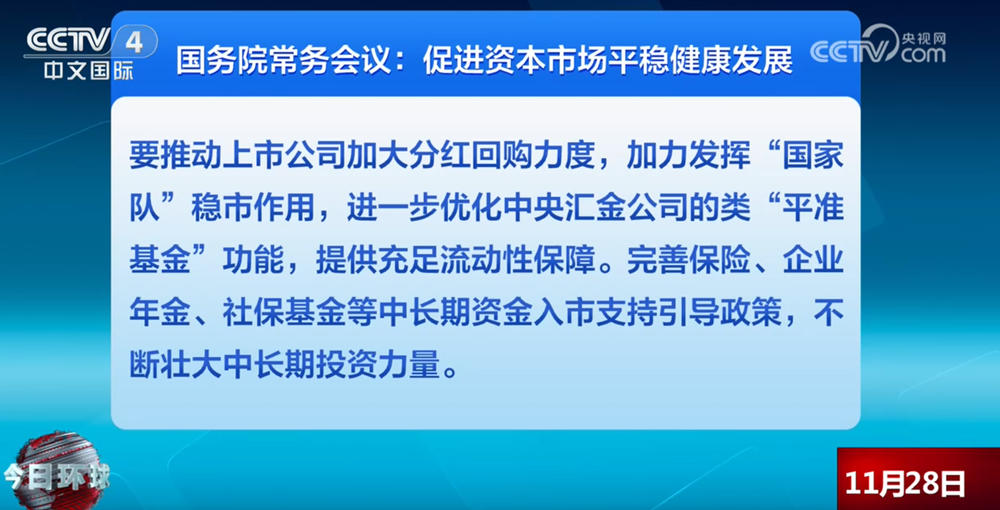
China’s State Council called for state-backed investors, known as the “national team,” to play a larger role in stabilizing the stock market. At a November 27, 2026, executive meeting on capital market reforms, the cabinet said Central Huijin’s role should be strengthened so it can act much like a market stabilization fund and provide ample liquidity.
The cabinet called for listed companies to increase dividends and share buybacks. It also urged better policies to support investment by insurers, enterprise pension plans and social security funds, with the aim of attracting more medium- and long-term capital.
The State Council said measures to counter market swings should go hand in hand with longer-term reforms, including faster development of a multi-tier capital market. It also called for stronger safeguards against risks originating abroad and closer oversight across the market, including enforcement against financial fraud and share sales that violate rules intended to protect investors.
The China Securities Regulatory Commission met the same day to discuss implementation. It said it would carry out existing policies and work with other authorities to develop and issue additional measures. It did not specify what those measures would be.
Market trading and fund flows
Mainland A-share turnover again exceeded 2 trillion yuan on November 27. The Shanghai Composite closed up 3.73%, the Shenzhen Component rose 7.24%, the ChiNext Index gained 11.61% and the STAR 50 jumped 15.07%. Nearly 5,400 stocks rose, with more than 400 reaching their daily price limits. Almost every industry sector advanced.
Liu Yu, chief economist at Industrial Securities and deputy director of its economics and finance research institute, said this was the first time the term “national team” had appeared in a State Council executive meeting readout. In Liu’s assessment, the announcement during trading hours went further than expected. He said the cabinet had clarified Central Huijin’s stabilization role and signaled that it wanted long-term investors to stay in the market.
Regulators told reporters that equity exchange-traded funds had recorded about 800 billion yuan in net subscriptions since early October, bringing their total assets to 2.9 trillion yuan. Broad-based blue-chip funds, including those tracking the CSI 300 and the SSE 50, accounted for 400 billion yuan in net subscriptions.
Over the same period, public mutual funds, brokerages trading for their own accounts, private securities funds, social security funds and insurers were all net buyers, according to regulators. Share buybacks and stake increases involving listed companies totaled nearly 60 billion yuan.