China aims to deploy 5G-Advanced and 10-gigabit optical networks in priority areas and largely complete a low-Earth-orbit satellite internet system by 2030. An implementation plan made public on November 26, 2026, sets a broader goal of comprehensive coverage and leading network performance by the end of the decade. It calls for 6G network construction to begin when the time is right, without specifying a launch date.
The Ministry of Industry and Information Technology issued the plan jointly with the Cyberspace Administration of China and the National Development and Reform Commission. It envisions networks that connect people, machines, objects and intelligent agents, with coverage extending beyond land to the air, space and sea.
The plan calls for research on 6G, ultra-high-speed optical communications and satellite communications, as well as development of base stations, core network equipment and new smart devices. Wang Zhiqin, vice president of the China Academy of Information and Communications Technology, said the work could benefit suppliers across the industry, including makers of high-speed components, chips and testing instruments.
Where 5G is already in use
The industry ministry has launched a new round of city pilots combining 5G with the industrial internet. As of November 2026, 5G applications were in use across all 97 major categories of China’s economy. Tang Libo, deputy director of the academy’s Institute of Technology and Standards, said the country had more than 27,000 industrial internet projects using 5G.
At a toothpaste factory in Kunming, Yunnan, more than 7,500 sensors feed production data over a private 5G network to a cloud-based model. The system tracks materials and coordinates production from the arrival of ingredients to the dispatch of finished goods. Dang Yabin, who heads the company, said inspection efficiency had increased more than 300-fold, cutting a process that once took over ten hours to a few minutes. He said mobile processing units connected by 5G could also take processing lines directly to fields where farmers grow medicinal herbs.
In Hulunbuir, Inner Mongolia, an open-pit mine completed what CCTV described as China’s first verification of gigabit upload speeds over 5G-Advanced in that setting. Nearly 100 driverless electric mining trucks operated around the clock, loading and unloading, avoiding obstacles and swapping batteries automatically. CCTV reported that, compared with conventional 5G, the system improved overall transport efficiency by 20% and reduced the cost of hauling a tonne of coal by 10%.
What the 6G pilots will test
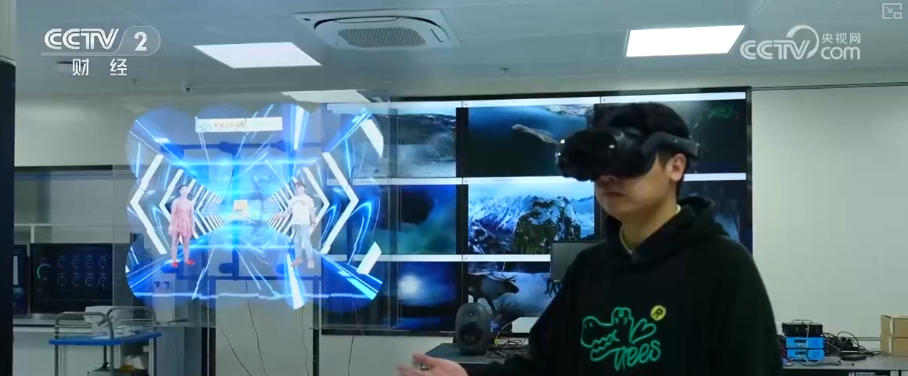
In a separate ministry-led pilot program, eight provinces and municipalities, including Beijing, Hebei and Jiangsu, will explore potential 6G uses in immersive communications, manufacturing, embodied intelligence and ocean applications. The work will cover new devices, key components, operating systems and satellite internet.
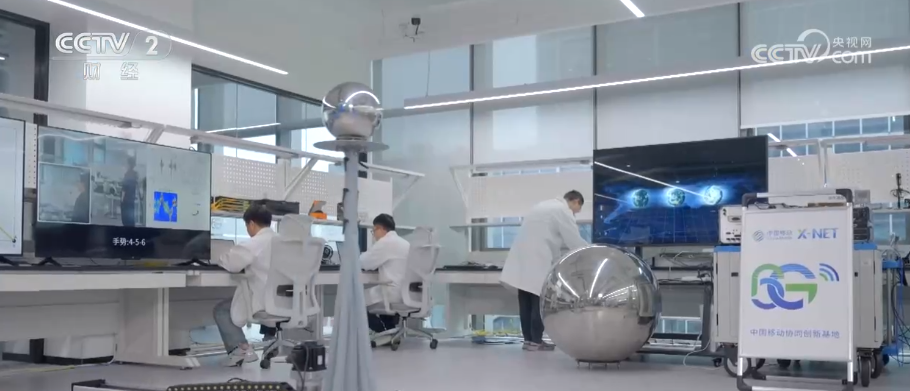
At a laboratory in Nanjing, Jiangsu, researchers are testing whether several 6G base stations can work together to track moving objects. Future stations could perform this radar-like sensing function alongside communications, with potential uses in low-altitude aviation and autonomous driving. CCTV reported that using multiple stations can improve sensing accuracy by about 25% compared with a single station. Zhong Ziguo, a researcher at Purple Mountain Laboratories, said observing the same airspace from different positions could improve detection and identification of small airborne objects.
Liu Guangyi, a group-level chief expert at China Mobile, said early tests could show how well networks work with new devices and services, with the aim of making them ready for commercial use before 2030.